
Choosing the Right Hardware for a Vision System (and Why We Don't Start There)
It's tempting to think a machine vision project starts with a camera. In practice, if you're picking the camera first, you're already working backwards.
The part decides the hardware, not the other way round
Every piece of hardware in a vision system exists to answer questions that only the part itself can raise. How fast is it moving? Is it reflective, transparent, textured, or some combination that changes from batch to batch? What's the smallest defect that actually matters, and how much smaller than that do we need to see? Is the inspection happening in bright ambient light, total darkness, or somewhere that changes throughout the day?
Only once those questions have real answers does hardware selection start. A part moving past on a conveyor might call for a linescan camera rather than a standard area scan. A reflective surface might rule out direct lighting entirely in favour of a diffuse dome. A tolerance measured in microns might mean a telecentric lens is the only option, because a standard lens introduces exactly the kind of distortion that a tight tolerance can't absorb.
This is also where most of the engineering time goes on a project, not in writing inspection software, but in getting the physical setup right before a single image is even captured.
Why it matters that we're not tied to one brand
A lot of the machine vision market is built around a single company's ecosystem: their cameras, their software, their lighting, sold as a package. That's not necessarily wrong, but it does mean the recommendation is shaped by what's in the catalogue, not only by what the part needs.
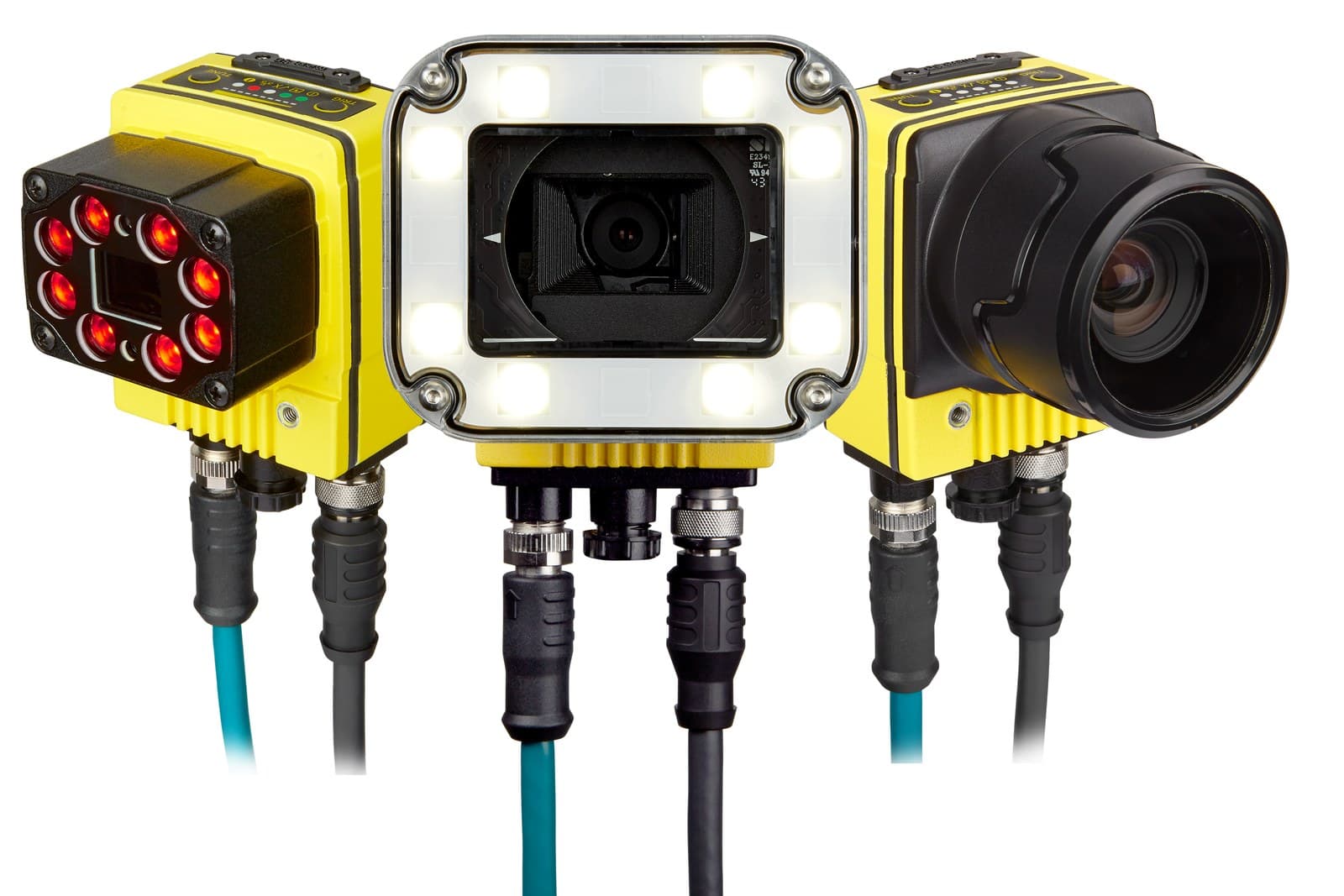
We work the other way round. We're independent across cameras, lenses, lighting and software, and we treat that as a design constraint that works in the client's favour rather than a limitation. If a Cognex smart camera is the right fit for a job, we'll use one. If the application calls for a different sensor, a different lens manufacturer, or a bespoke lighting rig that doesn't come from any single supplier's brochure, that's what goes into the system instead.
The result isn't a bigger catalogue for its own sake. It's that the recommendation you get is about your part, your line, and your tolerances, rather than about which supplier we have the best relationship with.
What this looks like in practice
On a recent project inspecting rapid diagnostic test cartridges, the contamination we needed to catch was smaller than half the width of a human hair. That drove the choice of a linescan camera paired with a telecentric lens, specifically because a standard lens's depth of field wasn't tight enough to hold that level of detail reliably across every part.
On another project, inspecting consumer packaging across six faces at full production speed, the challenge wasn't resolution at all, it was that the artwork itself changes constantly across product variants, while the actual defects don't. That called for a different combination entirely: multiple linescan cameras working together, paired with a deep learning model trained to separate genuine damage from ordinary design variation.
Neither setup came from a single supplier's off-the-shelf package. Both came from working out what the part demanded, then sourcing hardware to match.
The takeaway
A vision system that starts with “here's the camera we sell” is solving for the wrong variable. Start with the part, the defect, and the line it runs on, and the hardware selection becomes a much shorter conversation, because most of the options rule themselves out.