
It Scans, So It's Fine? Why Barcode Quality Is More Than a Pass or Fail
Most people check a barcode by scanning it. If it reads, it's fine. If it doesn't, there's a problem.
That works on the day, on that scanner, under that lighting. It doesn't tell you whether the code will still read further down the supply chain, on a different scanner, after the label has been rubbed in transit or printed on a slightly worn print head. A code can read perfectly well on your line and still fail at a customer's goods-in.
That's the difference between reading a code and verifying it.
Reading versus verifying
A reader answers one question: can I decode this? A verifier answers a different one: how good is this code, and how much margin does it have before it stops reading?
Verification grades a code against an international standard. For 1D barcodes that's ISO/IEC 15416, and for 2D codes such as Data Matrix it's ISO/IEC 15415. Each code gets an overall grade from A down to F, worked out from a set of individual measurements.
What gets measured
The exact list depends on the type of code, but the measurements look at things like:
- Contrast, meaning how clearly the dark parts of the code stand out from the light parts.
- Modulation, which is how consistent that contrast is across the whole code.
- Quiet zone, the clear space around the code that a scanner needs to find where it starts and stops.
- Damage, such as missing or smudged elements, and for 2D codes, how much of the built-in error correction has already been used up just to read it.
- Print growth and distortion, where the elements have spread, shrunk or been stretched out of shape.
The overall grade is set by the worst of those measurements. So a code with excellent contrast can still come out with a poor grade if its quiet zone is too tight.
Why it matters
Many industries now set a minimum grade, not just a requirement that the code reads. Medical devices are the obvious example. Codes used for traceability and unique device identification often need to meet a specified grade, because a code that can't be read at a hospital or a distributor isn't doing its job.
It's also a good time to check where you stand. GS1, the organisation behind most of the barcodes used in retail and healthcare, published version 26 of its General Specifications in January 2026. It doesn't bring in disruptive new rules for UK businesses, but it adds a new section setting out how GS1 standards relate to regulation, and all change notices are now kept in one place online. If your codes have to meet GS1 requirements, it's worth checking you're working to the current version.
Grading also gives you an early warning. A code that drops from an A to a C hasn't failed yet, but something is changing. It might be a print head wearing, a ribbon running low, or a label that's started to sit slightly off position. Catching that trend is much cheaper than finding out from a rejected delivery.
Doing it on the line, at speed
Traditionally, verification happens offline. Someone pulls a sample, puts it under a handheld verifier, and checks the grade. That's useful, but it only tells you about the codes you happened to pick up.
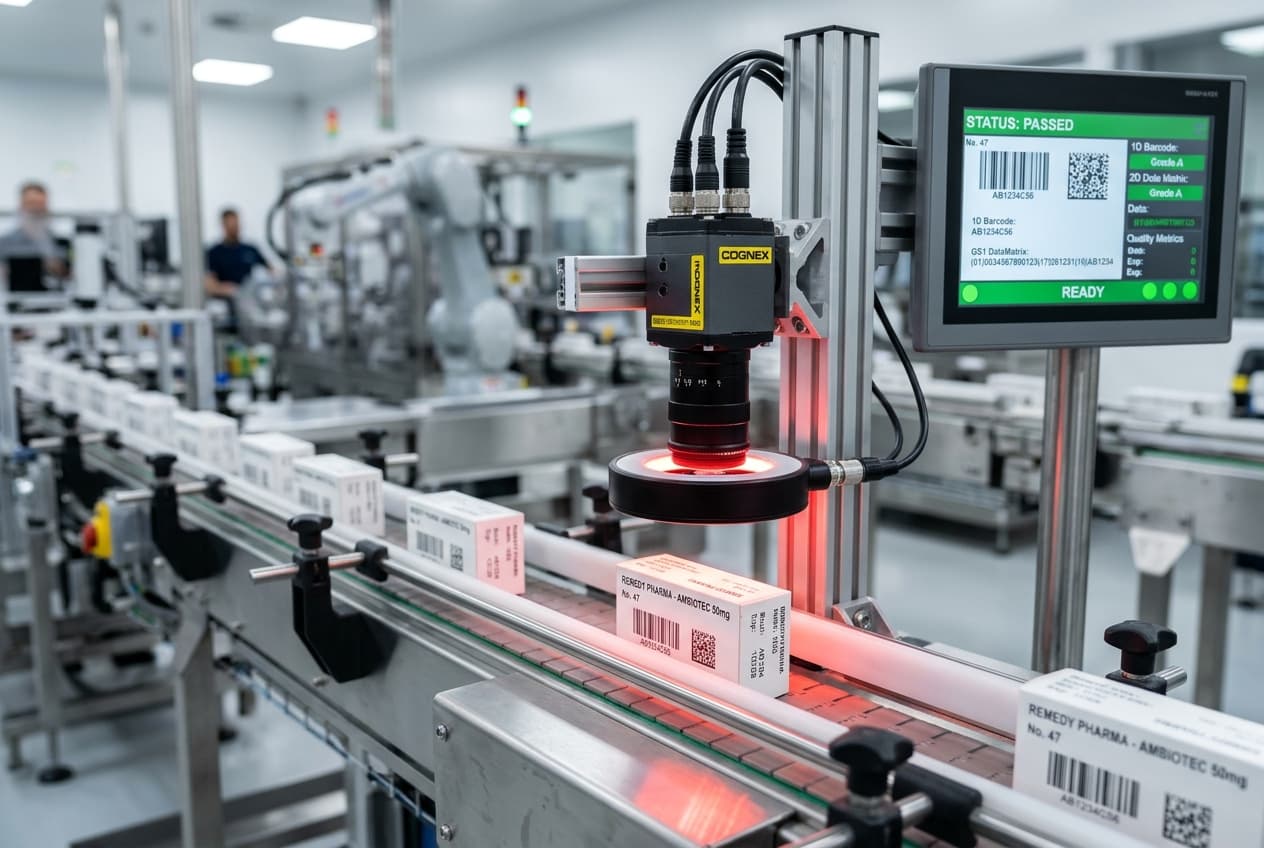
The alternative is to verify every code inline, while the line is running. That's harder than it sounds. Verification needs consistent, controlled lighting and a properly calibrated camera to produce grades that mean anything, and the product won't stop and wait for you. Getting the optics, lighting and mounting right is most of the job.
We recently helped Hologic do exactly this, checking codes against ISO standards at production speed. The full case study is on our website.
The short version
If your codes only need to read on your own scanner, a reader is enough. If they need to read reliably everywhere they go, and especially if a customer or regulator expects a grade, they need verifying. Doing that on every code, inline, means problems get caught at the printer rather than at the other end of the supply chain.
How we can help
Inline code verification is something we've done for manufacturers in medical devices, pharmaceuticals and packaging. We can look at the codes you're printing now, tell you what grade they're actually achieving, and recommend a setup that checks every one at full line speed.
Because we're independent of any single camera brand, the recommendation is based on your codes, your line and the standard you need to meet. We design the lighting and optics, install and commission the system, and train your team to run it.
If you're not sure whether your codes would pass, send us a few samples. Our engineers will grade them and let you know where you stand, and if there's a problem, what it would take to fix it.
Call us on +44 (0) 1933 62 51 62, email info@fishersmith.co.uk, or book a call with an engineer through our website.