
RoboVis Enables Complex Plumbing Parts to Be Automatically Assembled
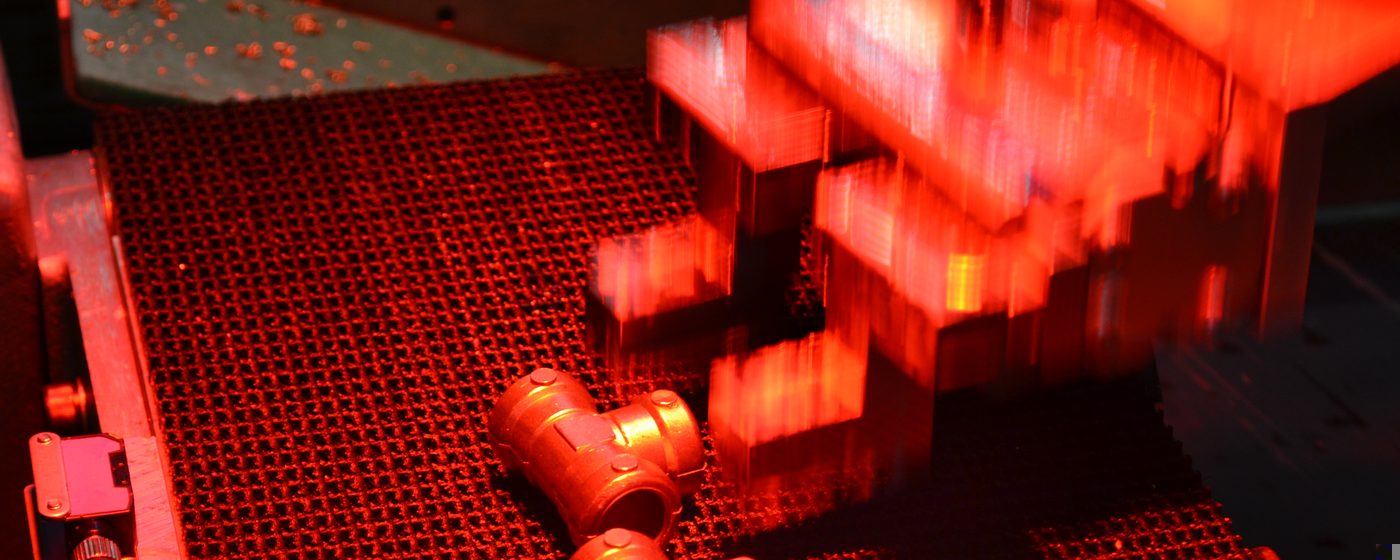
Integrating machine vision with a six axis robot has allowed complex plumbing parts to be automatically assembled.
Pegler Yorkshire manufactures copper and brass elbow joints, tees and valves in many sizes and configurations, assembled from several components before shipping. Small batch sizes across a wide part range meant the feed system had to be flexible, so Pegler Yorkshire chose Kawasaki Robot UK for the robots and FS Systems for the vision — limited only by part size (15mm or 22mm).
The challenge: specular metal on a moving belt
Parts feed from bowl or hopper feeders onto 200mm conveyor belts at 5m/min. RoboVis images the conveyor and passes pick co-ordinates to the robot, choosing the part nearest the end of the belt that it can reach without colliding with a neighbour. The conveyor stops for each pick — important for cylindrical parts that would otherwise roll — and the belting itself was chosen to limit rolling and reflection.
Up to 10 part types can be randomly scattered across a 260 × 200mm area. Brass and copper are highly specular, so illumination is critical, and the system also has to look past metal fragments left on the belt from production.
Custom illumination and camera setup
Ringlights don't work here — reflection varies too much with a cylindrical part's position on the belt. Instead, FS Systems had Vision & Control build custom 300 × 240mm, 630nm red LED panels, mounted around 1m above the conveyor with a camera at the panel's centre to capture direct on-axis reflection. Images pass to a host PC, which drives the six-axis Kawasaki robot over Ethernet.
Pick logic and part recognition
The system picks the most efficient part first, checking for collisions with neighbours; if none can be safely picked, the conveyor advances and all parts recycle back to the hopper. Analysis runs on Halcon, embedded into the RoboVis software.
- Calibration: a known-good part is imaged at a known position to set the datum
- Metal fragments removed by smoothing, then the part is thresholded out of the image
- Geometric shape-recognition builds a mathematical model of the part
- Live pick co-ordinates are then calculated relative to the datum for each part in view
In use at Pegler Yorkshire
RoboVis works both as an operator screen (choosing which parts to run) and a machine-setter tool (creating new component recipes), letting staff visualise the system, calibrate against a known object, and set the image-processing steps it runs. More than 15 RoboVis systems are now in use at Pegler Yorkshire in the UK, USA and Hungary.